Sustainable refurbishment with architectural film. The evidence.
Sustainability in interior refurbishment is moving beyond good intentions into measurable outcomes. This guide covers the evidence for architectural film as a low-waste, low-carbon refurbishment method, and how to document it for procurement scoring, ESG reporting and carbon reduction targets.
Every refurbishment now gets asked the same question somewhere in the process: what happens to the waste, and what does this cost in carbon? For a full strip-out and replacement, the honest answer is rarely a good one. This guide sets out the evidence for architectural film as a genuinely lower-waste, lower-carbon alternative, where that evidence is strong, where it is weaker, and how to document it credibly rather than as a marketing claim.
A conventional strip-out and replace generates tonnes of waste per project. Doors, joinery, worktops, wall panels and furniture come out, and most of it goes to landfill or an energy-intensive recycling process rather than being reused. Layered on top of that is the embodied carbon in whatever replaces it: manufacturing, processing and transporting new materials all carry a carbon cost before the new fit-out has done a single day of service.
The irony is that most of what gets ripped out during a typical refurbishment is structurally sound. It gets replaced because it looks dated, not because it has failed. That is precisely the gap architectural film is designed to close.
There is a financial dimension to this too, one that rarely appears in a sustainability conversation but often decides it in practice. Skip hire, waste transfer documentation and disposal costs for commercial-grade materials are not trivial line items on a refurbishment budget, and they scale directly with how much gets stripped out. A refurbishment method that avoids the strip-out avoids that cost entirely, which is one reason procurement teams and sustainability teams increasingly ask the same question from different directions.
How architectural film changes the equation
Wrapping keeps every substrate in place. There is zero demolition waste, zero skip hire and zero materials sent to landfill as a direct result of the work. The film itself is a thin surface layer, so the material volume involved is a fraction of what a replacement door, worktop or reception desk would require.
The energy input of installation matters too. Architectural film is hand-applied with a heat gun, not manufactured in a factory and shipped to site. That installation energy is negligible next to the energy cost of manufacturing a replacement kitchen, a full run of doors, or a new reception desk from scratch.
There is a second, less obvious saving in occupied buildings. Because there is no strip-out, spaces rarely need to be vacated or decanted into temporary accommodation while work happens. An office floor, a hotel corridor or a hospital ward can stay in use around a wrapping programme scheduled out of hours or room by room, which removes the operational disruption and the associated carbon cost of relocating people and equipment that a full refit usually requires.
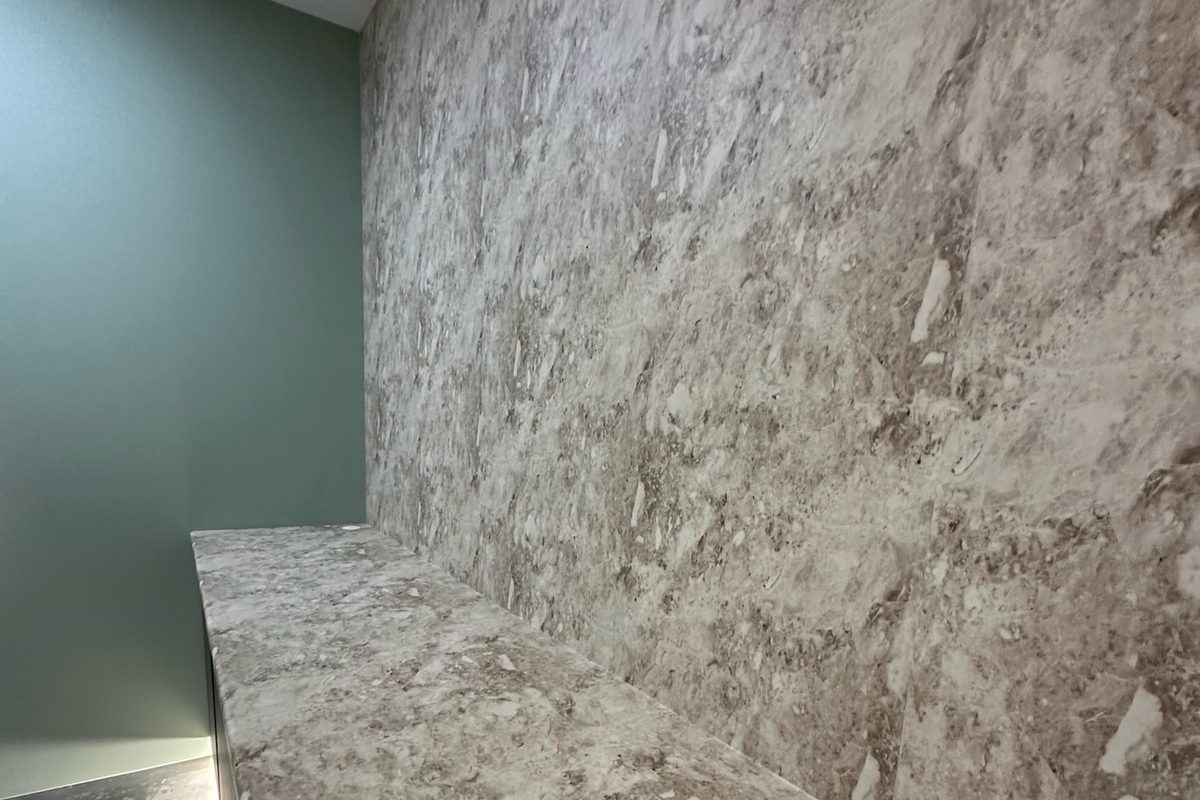
The wall underneath stays exactly where it is — only the surface changes.
Embodied carbon comparison
Precise carbon figures depend on the specific project, the substrates involved and the replacement that would otherwise have been specified, so this guide will not invent numbers that don't hold up to scrutiny. What is unambiguous is the direction and the scale of the gap, which shows clearly across a typical office refurbishment covering a run of doors, a reception desk and a washroom.
Factor
Traditional replacement
Architectural film wrapping
Materials manufactured
Full new doors, desk and panels
Thin surface film only
Materials to landfill
Old doors, desk and panels stripped out
None — substrates retained in place
Transport
Bulky replacement units delivered to site
Rolls of film — a fraction of the volume
Installation energy
Fitting, disposal and site clearance
Hand application with a heat gun
Overall embodied carbon
Significantly higher
Significantly lower
The honest note: this is a qualitative comparison, not a certified life-cycle assessment, because that depends on the specific materials and project in question. But the direction of the gap is not in question, and for most refurbishment programmes it is large.
Formal life-cycle assessment frameworks such as those referenced by BREEAM and RICS SKA ratings are increasingly used to score refurbishment methods on exactly these categories, and surface refurbishment methods like wrapping are gaining recognition within them precisely because the retained-substrate argument is straightforward to demonstrate, even where a full certified LCA has not been run for a specific project.
Circular design and re-wrapping
Film can be removed and the surface re-wrapped when tastes change or the next refurbishment cycle comes round. That extends the useful life of the substrate through multiple visual refreshes, rather than one replacement cycle ending in landfill.
The contrast with a straight replacement is stark. A replaced door that reaches the end of its visual life becomes landfill. A wrapped door that reaches the end of its film's life can simply be re-wrapped, indefinitely, as long as the substrate underneath remains sound.
This maps well onto how often interiors are actually refreshed in practice. Hotel rooms are commonly refreshed on a five-to-seven-year cycle, offices on a seven-to-ten-year cycle, and student accommodation between academic contracts. A replacement-based refit forces the whole unit to be rebuilt on that cycle. Re-wrapping lets the same substrate absorb several of those cycles before it is ever actually replaced, which compounds the waste and carbon saving every time the space is refreshed rather than rebuilt.
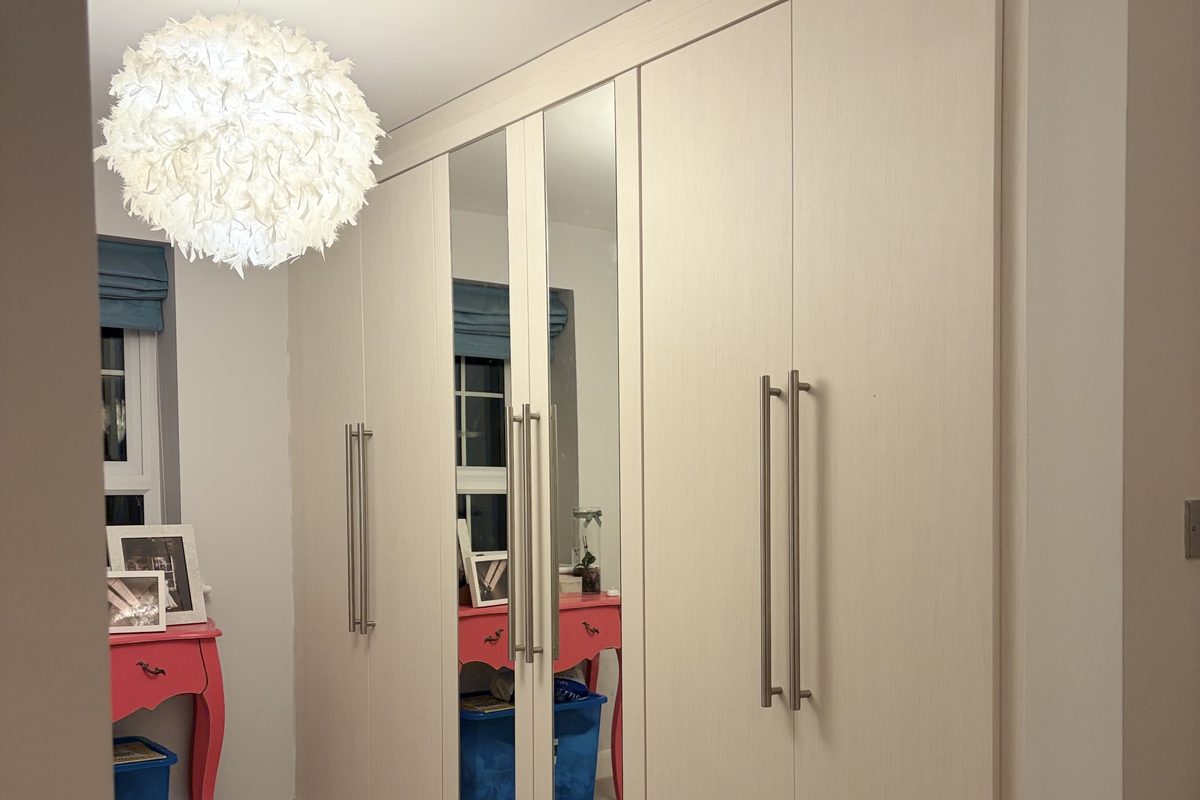
The same wardrobe carcass, refreshed — a substrate that can be re-wrapped again when the next refresh is due.
Documentation for procurement and ESG
For organisations with sustainability targets — universities, NHS trusts, corporates — wrapping provides documentable waste and carbon reduction, not just a good story. Velfi provides material specifications, waste reduction data and confirmation of materials kept in use for every project, formatted for procurement scoring and ESG reporting rather than as marketing copy.
This is procurement-level evidence, the kind sustainability teams and procurement boards are actually equipped to score, not a general sustainability statement attached to a quote. See sustainable interior refurbishment for the wider service, and the specification detail in the designer's specification guide.
In practice, that documentation covers the number of units re-surfaced rather than replaced, an estimate of the material volume and weight kept out of landfill, and written confirmation of what was retained versus what would have been discarded under a replacement specification. That level of detail is what turns a sustainability claim into something a procurement scorecard can actually accept.
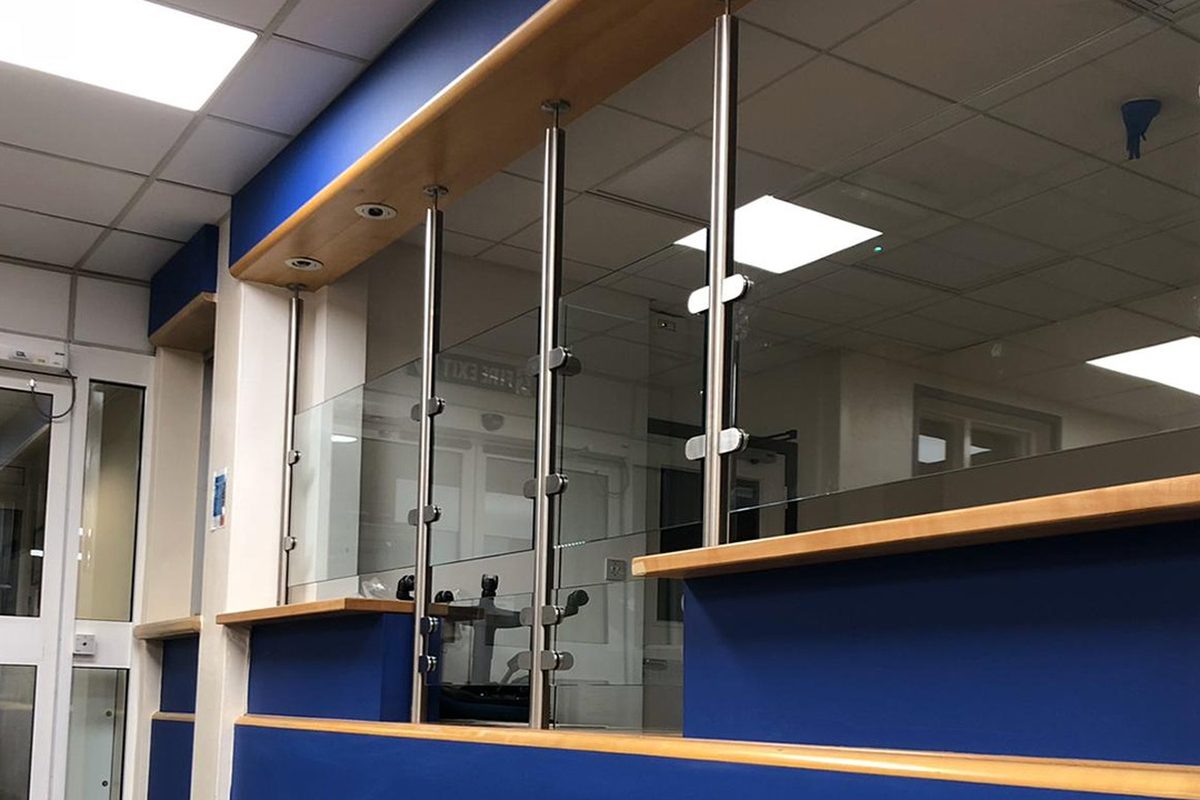
An NHS reception desk refreshed rather than replaced, with waste and material data available on request.
Where sustainable refurbishment has the biggest impact
The gap between replacement and wrapping is most dramatic on high-volume programmes: student accommodation refurbished room by room, hotel room turnarounds across dozens of units, and multi-floor office refreshes covering hundreds of doors and desks.
A 200-room student hall refurbishment that keeps every wardrobe, desk and door in use rather than skipping them is not an abstract sustainability claim — it is a measurable outcome, multiplied by the number of rooms in the programme.
Healthcare estates see a similar multiplier. NHS trusts typically refresh clinical and reception areas on a rolling basis across many sites, and a wrapping programme that avoids ward closures and demolition waste at each site adds up to a substantial cumulative reduction across an estate-wide refurbishment plan, not just a single building.
The honest limitations
Film cannot fix a structurally damaged substrate. If the material underneath is water-damaged or failing, replacement is the right answer, and a credible installer will say so rather than wrapping over a problem.
Film is not infinitely recyclable either — it is a plastic-based product with a finite life of 10 to 12 years, and it should be described honestly as that rather than as a zero-impact material. The sustainability case is strongest in comparison to the realistic alternative, full replacement, not as an absolute claim in isolation. That honesty is what separates a credible sustainability position from greenwashing.
It is also worth being clear that reclaimed or genuinely secondhand materials can, in principle, carry an even lower carbon footprint than any new surface treatment, film included. In practice, sourcing reclaimed materials at the scale and consistency a commercial refurbishment programme needs is rarely realistic. Architectural film sits as the practical, scalable option between a wasteful full replacement and an ideal that is difficult to deliver at volume.
Common questions
Questions people actually ask.
Compared to full replacement, significantly yes. It eliminates demolition waste, keeps substrates in use and avoids manufacturing replacements. It is not zero-impact, but the gap versus replacement is large and documentable.
Yes. Material specifications, waste reduction confirmation and data on materials retained can be provided for ESG reporting and procurement scoring.
10-12 years with manufacturer warranty. This is a long-life refurbishment, not a temporary fix.
Yes. The film can be removed and the substrate re-wrapped, extending its useful life through multiple refurbishment cycles.
It is disposed of as general commercial waste. The substrate underneath remains in use, which is where the sustainability benefit lies — the structure stays, only the surface is renewed.
Refurbish without the waste. Documented on request.
Send details of the space and Velfi will confirm which surfaces can be wrapped, the waste and carbon impact versus replacement, and a fixed quote within 48 hours.