Cheap vinyl or architectural film? Why one peels and one doesn't.
Most bad wrap stories start with a cheap roll, a quick fit, or both. Here's what actually separates a sticky-back roll from architectural film, how long each lasts, and why any wrap peels, from someone who's spent nearly 10 years fitting the good stuff and peeling off the rest.
By Oscar Dean · Published 20 November 2026
Short answer: cheap self-adhesive vinyl is a thin decorating product, and in a kitchen or bathroom it often starts lifting at the corners within the first year. Architectural film is a heavier interior grade made to bond to furniture, doors and walls for years, and manufacturers back it with 10 to 12-year warranties. The film is half of it. The other half is how it's fitted.
What's the difference between cheap vinyl and architectural film?
Both come on a roll and both stick to things. That's where the similarity ends.
Thickness. Architectural film is noticeably thicker and heavier. That's what lets it take knocks, daily cleaning and hands on the same door handle for years without wearing through or showing every lump underneath.
Adhesive. Cheap rolls use an adhesive made to be easy, not to last. Architectural film uses an adhesive designed to bond to prepared furniture board, metal and painted surfaces long term, and on edges and corners it's fitted with a primer so it can't creep back.
Texture. Cheap vinyl is usually a printed picture of wood or marble on a flat, shiny surface. Good architectural films are embossed, so the grain or stone has a feel to it. You notice it from across the room, and you definitely notice it up close.
Fire classification. Architectural films are tested and classified under EN 13501-1, the European fire standard. DIY rolls usually aren't. At home that rarely matters. In an office, a corridor, a lift or on a fire door, it matters a lot. The fire ratings guide covers the detail.
Warranty. 3M DI-NOC carries a 12-year warranty, and Cover Styl and Metamark MiA carry 10 years. A roll from a DIY shop carries nothing once it's on your cupboard.
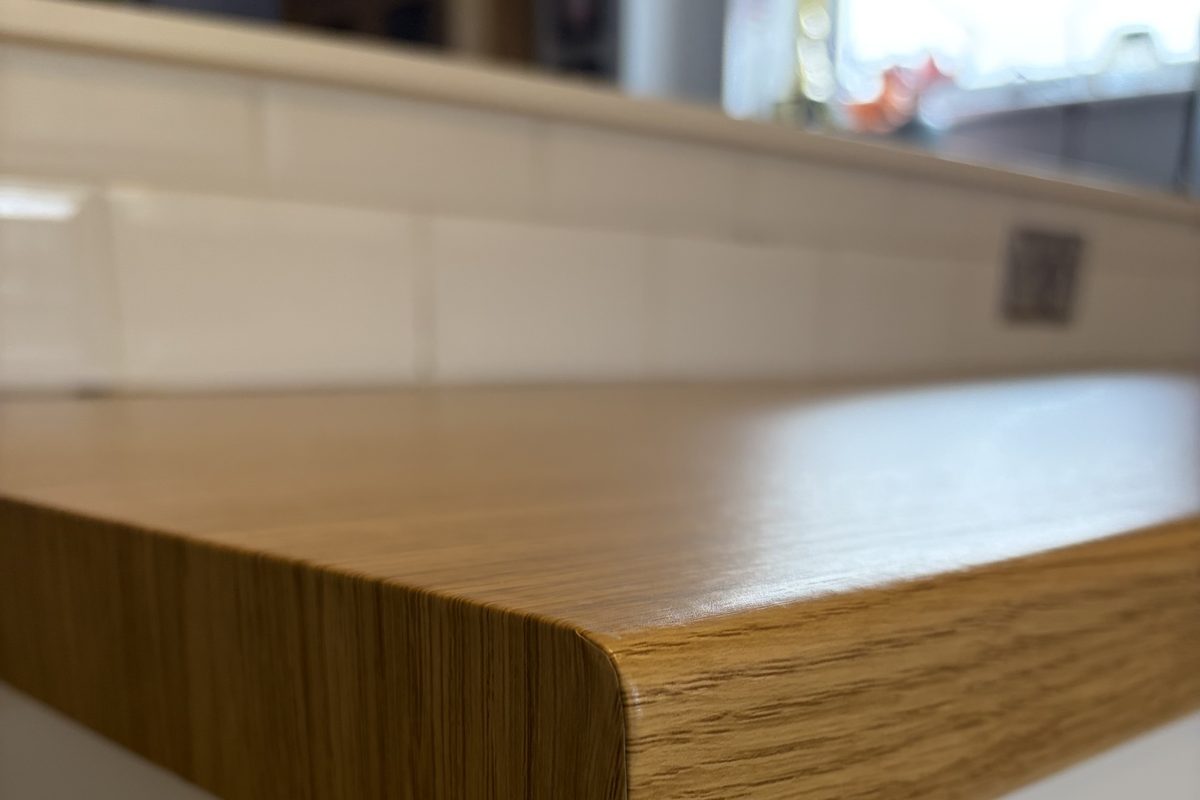
A wrapped worktop edge in 3M DI-NOC. The film goes round the edge, not up to it, which is what stops it lifting.
Cheap vinyl: on a bookshelf, years. On a kitchen door next to the kettle, or anything that gets wiped every day, the corners often start lifting within the first year. Once one corner goes, dirt gets under it and it keeps going.
Architectural film: the manufacturers' warranties run 10 to 12 years, and that's what they're prepared to stand behind on interior surfaces. Real life depends on use. A wardrobe door will look the same for a very long time. A kitchen drawer front that gets kicked shut every day will show wear sooner, which is why the film is chosen for the job and not just the colour.
For kitchens in particular, is kitchen wrapping worth it? goes through lifespan, wrap vs spray vs paint, and when replacing is the better call.
Why does a wrap peel?
Good film fitted badly peels. So does cheap film fitted well. Nearly every failed wrap comes down to one of these.
Cause
What happens
How it's avoided
Dirty or polished surface
Grease or furniture polish stops the adhesive bonding
Degrease and clean before anything goes on
Edges trimmed flush
The edge has nothing to hold it and creeps back
Wrap film round the edge and onto the back
No primer on corners
Corners and tight returns lift first
Prime edges, corners and returns
Heat and steam
Ovens, dishwashers and kettles soften the adhesive
Heat shields, and the right film near appliances
A weak surface underneath
Flaking paint or swollen MDF lets go, taking the film with it
Repair or replace the panel first, or say no to it
Harsh cleaners
Solvents and scourers wear and loosen the film
Warm soapy water and a soft cloth
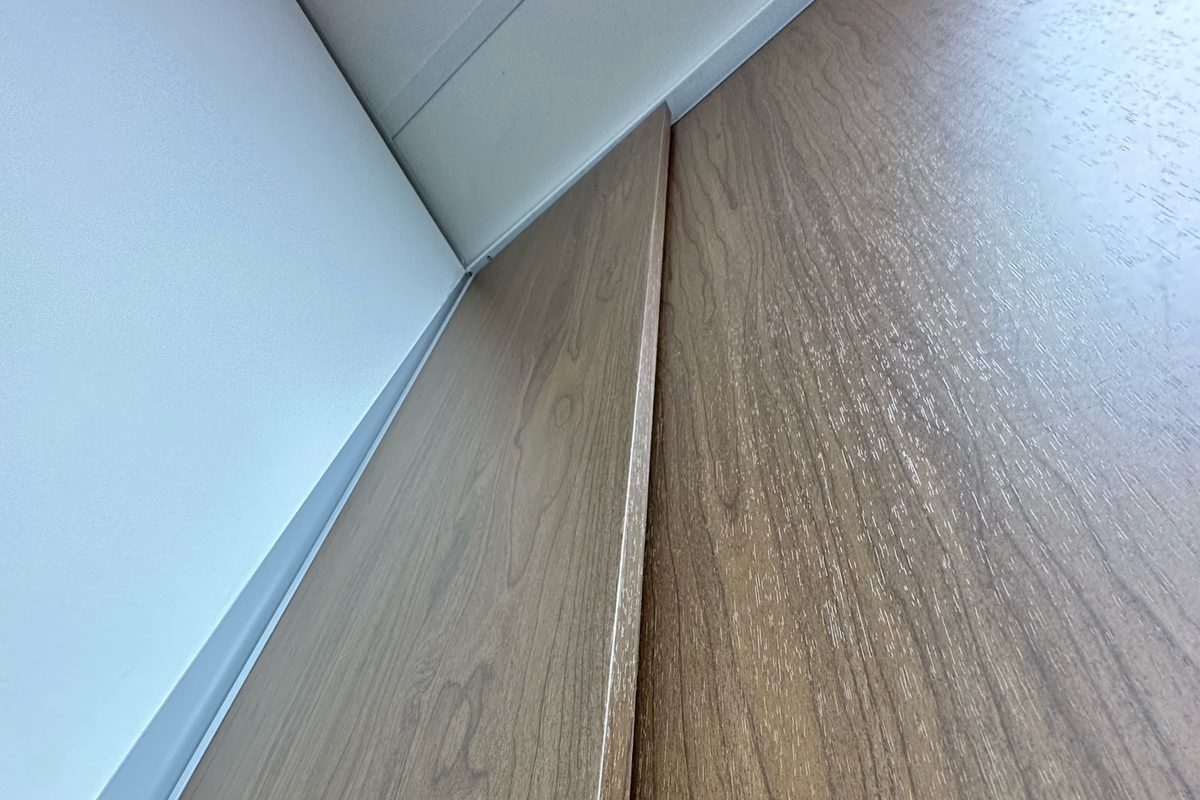
Edge detail on an office partition. Edges are where wraps fail, so they get the most time.
How can you tell which one you've got?
If you're buying a fitted wrap, ask which film it is, by brand and range. A fitter using architectural film will tell you straight away and can show you the data sheet. If the answer is vague, that tells you something too.
If it's already fitted, look at the edges. Film that wraps round onto the back of a door is a good sign. Film cut off neatly at the front edge is the one that lifts. Run your hand over a wood effect: if it feels like the real grain, it's almost certainly architectural film. If it feels like a shiny photo, it probably isn't.
When is cheap vinyl good enough?
Sometimes it is, and there's no point paying for more than you need.
A shelf, a drawer liner, a piece of furniture that hardly gets touched, or a quick change in a rented room you're leaving in a year: cheap vinyl will do. Anything that gets handled, wiped, heated or splashed every day, anything in a commercial building, and anything you want to still look right in five years needs architectural film, fitted properly. You can see the range we use in the film library.
If you've got a wrap that's lifting, or you're weighing up a quote, send a photo. You'll get a straight answer on what's gone wrong or what you're being offered, and a fixed quote within 24 hours if you want us to do it.
Written by Oscar Dean, founder of Velfi Interiors. Nearly 10 years fitting architectural film and window film on homes and commercial sites. About Oscar
Common questions
Quick answers to common questions.
They're related but not the same product. Both are self-adhesive films, and most are PVC. Architectural film is a heavier interior grade made for furniture, doors, walls and fixtures, with embossed textures, an adhesive designed to stay put for years, and fire classification. The rolls sold as sticky-back or DIY vinyl are a thinner, cheaper grade.
Fitted properly, rarely. When it does, the cause is nearly always preparation, edges or heat rather than the film: a greasy or polished surface, edges trimmed flush instead of wrapped round, no primer on corners, or a door right next to an oven. That's why the fitting matters as much as the film.
Manufacturers warrant their interior architectural films for 10 to 12 years, for example 12 years on 3M DI-NOC and 10 years on Cover Styl and Metamark MiA. How it looks over that time depends on how hard the surface is used and how it's cleaned.
No. New film over old film just inherits the old problem. The peeling film comes off, the surface underneath is cleaned and repaired, and the new film goes onto a sound base.
You can buy it, and on a flat panel with no edges you might get away with it. Edges, corners, handles and joins are where the skill is. A DIY fit of good film usually fails in the same places as a DIY fit of cheap vinyl, and manufacturers' warranties usually depend on the film being fitted to their instructions.
Wrap lifting, or weighing up a quote?
Send a photo. Get a straight answer.
Show us the surface and tell us what's happening. You'll hear what's gone wrong or what you're being offered, and get a fixed quote within 24 hours.